Rainscreens are usually discussed in terms of water — and rightly so. But the same geometry that drains and dries a wall also makes it more energy-efficient. By holding the cladding off the structure, a rainscreen creates room for the one thing that most improves a wall's thermal performance: continuous exterior insulation.
Continuous insulation and thermal bridging
In a conventional wall, insulation sits between the studs — and the studs themselves, along with slab edges and other structural members, conduct heat straight through the wall. These thermal bridges quietly erode the assembly's real-world performance, no matter how high the rated R-value of the cavity insulation.
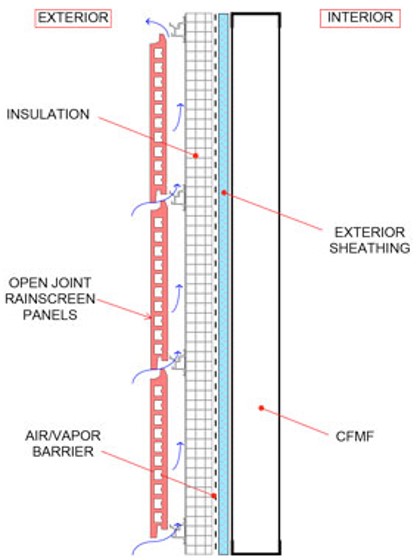
A rainscreen lets you wrap the structure in an unbroken layer of insulation outside the sheathing, in the space created by the cavity. That continuous insulation covers the studs and slab edges that would otherwise bridge heat, so the wall performs much closer to its theoretical value. The result is a more efficient envelope and a more comfortable, evenly tempered interior.
The cavity isn't just a drainage path — it's the room that lets you insulate the building continuously, on the outside, where it does the most good.
A drier wall is a better-performing wall
Energy performance isn't only about insulation thickness; it's also about keeping the assembly dry over time. Wet insulation loses effectiveness, and moisture trapped in a wall degrades materials and invites bigger problems. Because a rainscreen drains incidental water and ventilates the cavity, the insulation and structure stay dry — so the envelope keeps performing the way it was designed to, year after year.
Codes, LEED and the DMV
For commercial and institutional projects in Washington DC, Maryland and Virginia, continuous insulation behind the cladding is often what carries a wall over the line on energy-code requirements, and it can contribute toward LEED credits. In a region with both humid summers and cold winters, a better-insulated, drier envelope also pays back directly in heating and cooling loads.
The takeaway
A rainscreen is a moisture-management strategy and an energy strategy at the same time. The cavity that keeps the wall dry is also what makes room to insulate it continuously — two of the biggest levers on long-term building performance, working together in one assembly.