Every rainscreen shares one core idea: hold the cladding off the wall, leave a cavity, and let that cavity drain water and dry the assembly. But not all cavities work the same way. The terms you'll see on a spec — vented, drained and back-ventilated, and pressure-equalized — describe different strategies for handling the air in that gap, and the difference matters most on tall or wind-exposed buildings.
The shared starting point: the cavity
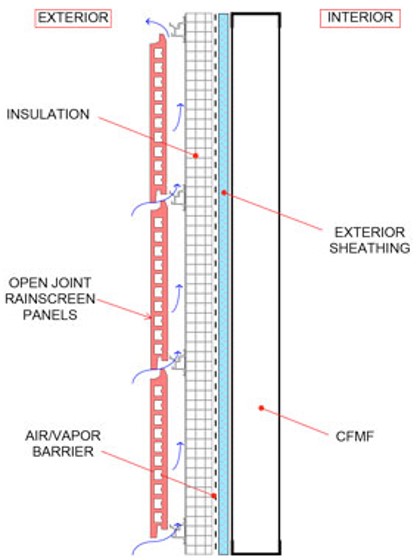
In any rainscreen, the outer panel is a screen, not a seal. Some water will always find its way past the joints — and the cavity behind the panel gives that water somewhere to drain and the wall a way to dry. A continuous weather-resistive barrier sits at the back of the cavity as the real waterproofing line. Where systems diverge is in how deliberately they manage air pressure across the cladding.
Vented and drained, back-ventilated rainscreens
A vented rainscreen keeps the cavity open — typically at the base and top — so air moves through it continuously. That airflow carries moisture out and keeps the wall drying. A drained and back-ventilated (DBV) system is the common refinement: it adds a deliberate drainage path so incidental water runs down the back of the panel while air still circulates.
This is the workhorse approach across the DC, Maryland and Virginia region. It's robust, forgiving of the bit of water that always gets in, and it pairs with essentially every panel material — fiber cement, metal, HPL, UHPC, terracotta. For most low- and mid-rise buildings, a well-detailed DBV rainscreen is exactly the right call.
Pressure-equalized rainscreens
A pressure-equalized rainscreen takes the idea one step further by managing the air pressure inside the cavity. The cavity is compartmentalized so that, when wind pushes on the façade, the pressure inside the cavity rises to nearly match the pressure outside. With little pressure difference across the joints, there's little force to drive rain through them in the first place.
The open joints look like they invite water in — but at the right spacing they equalize air pressure, so wind-driven water isn't pushed through. — a principle we see proven on open-joint projects across the District
That makes pressure-equalized systems especially valuable on taller structures and high-exposure sites — think buildings along the Potomac or in coastal Maryland, where wind-driven rain is a real design load rather than an afterthought.
How to choose for a DMV building
The decision usually comes down to height and exposure:
- Low- and mid-rise, typical exposure — a drained, back-ventilated rainscreen is reliable, economical and material-flexible.
- Tall buildings or high-wind sites — pressure equalization earns its added detailing by keeping wind-driven rain out under load.
- Either way — the membrane and its transitions at windows, parapets and penetrations are what actually keep the building dry. No cavity strategy rescues a poorly detailed WRB.
If you're weighing the two for a specific project, the building's height, location and cladding material together point to the right answer. That's a conversation we're happy to have early, while it can still shape the detailing.